Fundamentals of Tensile Testing and Its Operational Principles
Tensile testing is a standardized mechanical material testing procedure that evaluates the tensile mechanical performance of engineering materials under uniaxial tensile force. Conducted by professional tensile testing machines, this material strength test stretches standard specimens at a constant controlled speed until rupture. It captures accurate stress limits, strain capacity, and fracture behavior data, making it the most essential test method for material qualification, structural design verification, and industrial quality control. For manufacturing and material research industries, precise tensile testing ensures product stability, mechanical reliability, and full compliance with international testing standards.
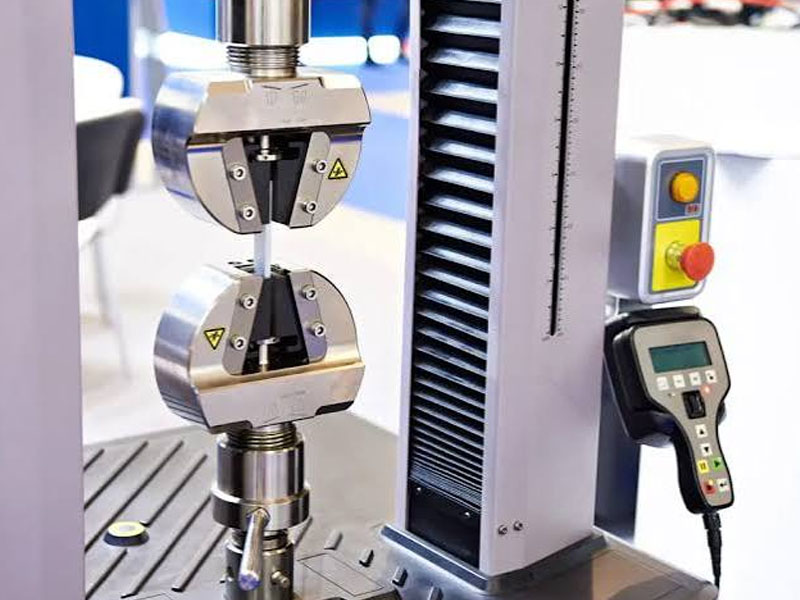
Definition and Core Objectives of Tensile Testing
As a fundamental destructive test in material engineering, tensile testing applies precise and stable tensile load to material specimens via a universal testing machine until structural failure. The test accurately measures key mechanical properties including ultimate tensile strength (UTS), yield strength, elongation at break, and area reduction. Meanwhile, critical material parameters such as Young’s modulus, Poisson’s ratio, and strain-hardening coefficient can be derived from professional stress-strain curve analysis.
All mechanical data obtained from material tensile testing provides authoritative technical support for material selection, mechanical component design, and product performance certification, which is indispensable for industrial quality inspection and standard compliance verification.
Also known as tension testing, tensile testing is applicable to a wide range of materials, including metals, plastics, polymers, rubber, and composite materials. It strictly complies with mainstream international standards such as ASTM D638, ensuring unified and repeatable test results across different industries.
Equipped with high-precision universal tensile testing machines, manufacturers and laboratories perform routine tensile strength tests to evaluate material mechanical stability under tensile load. This testing solution effectively avoids structural failure risks and is widely applied in aerospace, automotive manufacturing, construction engineering, and new material industries to guarantee long-term product safety and consistent mechanical performance.
Working Principle and Professional Data Calibration
The core working principle of tensile testing is to apply continuous axial tensile force to standard test specimens through a calibrated tensile test machine. The testing system synchronously records real-time load values and displacement changes to calculate tensile stress and tensile strain.
Tensile stress refers to the axial force borne per unit cross-sectional area of the specimen, while tensile strain represents the proportional deformation of the original specimen gauge length. The complete stress-strain curve generated during the test fully reflects the elastic deformation, yielding behavior, and plastic deformation characteristics of the material, realizing comprehensive material mechanical property characterization.
Key Mechanical Parameters in Tensile Strength Testing
Yield Strength and Ultimate Tensile Strength (UTS)
Yield strength is the critical stress value when a material changes from reversible elastic deformation to permanent plastic deformation, generally calibrated by the standard offset method in professional tensile testing. Ultimate Tensile Strength (UTS) is the maximum tensile stress that a specimen can withstand before fracture.
As two core indicators measured by universal testing machines, yield strength and UTS are key bases for material grade classification, structural load design, and industrial material performance evaluation.
Elastic and Plastic Deformation Behavior
In the elastic deformation stage tested by tensile testing equipment, materials can fully recover their original shape after load removal without permanent structural damage. Once the applied tensile stress exceeds the material yield limit, irreversible plastic deformation occurs.
Distinguishing between elastic and plastic mechanical regions helps engineers accurately judge material service performance, fatigue resistance, and structural safety margin under complex working conditions.
Professional Configuration of Tensile Testing Equipment
High-precision tensile testing relies on standard universal tensile testing machines, which are modular mechanical testing systems customized for material tensile performance detection. Standard machine configurations include high-precision load cells for accurate force collection, professional extensometers for micro-strain measurement, and standardized specimen grippers for stable clamping and axial alignment.
Pre-test zero calibration, fixture correction, and specimen centering are essential operation steps to eliminate system errors, ensuring high repeatability and accuracy of tensile strength test results for industrial quality inspection and laboratory research.
Classification and Core Advantages of Universal Tensile Testing Machines
Industrial-grade tensile testing machines are mainly divided into electromechanical and servo-hydraulic models, covering low, medium, and high full-range test loads. Different from single-function testing devices, the multifunctional universal testing machine supports tensile, compression, bending, and shear tests by replacing customized fixtures and testing accessories.
Reasonable selection of load cell capacity and strict mechanical alignment can effectively protect core testing components, ensuring long-term stable and precise operation of equipment for daily material tensile testing and industrial quality control.