Fundamentals of Flexural Bending Test: Principles, Procedures & Equipment
A flexural bending test is a standardized mechanical testing method designed to evaluate the bending stiffness, flexural strength, and deformation resistance of engineering materials such as plastics, polymers, and composite materials. This test quantifies material mechanical performance under bending load, providing critical technical data for material selection, structural design verification, and quality inspection in automotive, aerospace, construction, and new energy industries.
Key Takeaways
Flexural bending testing characterizes material stiffness and bending resistance, serving as an essential quality control procedure to verify material applicability for industrial structural components. The three-point and four-point flexural testing methods are the mainstream testing configurations in the testing machine industry. The three-point bending test focuses on maximum bending stress evaluation, while the four-point bending test effectively reduces shear interference and delivers more uniform stress distribution for higher testing accuracy. International standards including ASTM D790 and ISO 178 standardize specimen preparation, loading speed, and test procedures to ensure repeatable and reliable flexural test results.
Understanding Flexural Bending Testing Principles
Flexural bending testing is a fundamental mechanical characterization test performed on universal testing machines. The test applies continuous vertical load to a beam-shaped specimen to simulate actual bending working conditions. During testing, the specimen bears both tensile stress and compressive stress simultaneously, which comprehensively reflects the material’s flexural stiffness, ductility, and bending failure characteristics.
Different from tensile testing, flexural testing focuses on structural deformation resistance rather than material fracture performance. It is widely used to verify whether polymer and composite materials meet mechanical design thresholds, supporting industrial quality classification and product performance optimization.
Common Types of Flexural Testing Methods
Industrial flexural bending tests are mainly divided into three-point flexural testing and four-point flexural testing. These two standardized loading configurations cover most plastic and composite material testing scenarios, with distinct structural principles and application scopes.
Three-Point Flexural Test
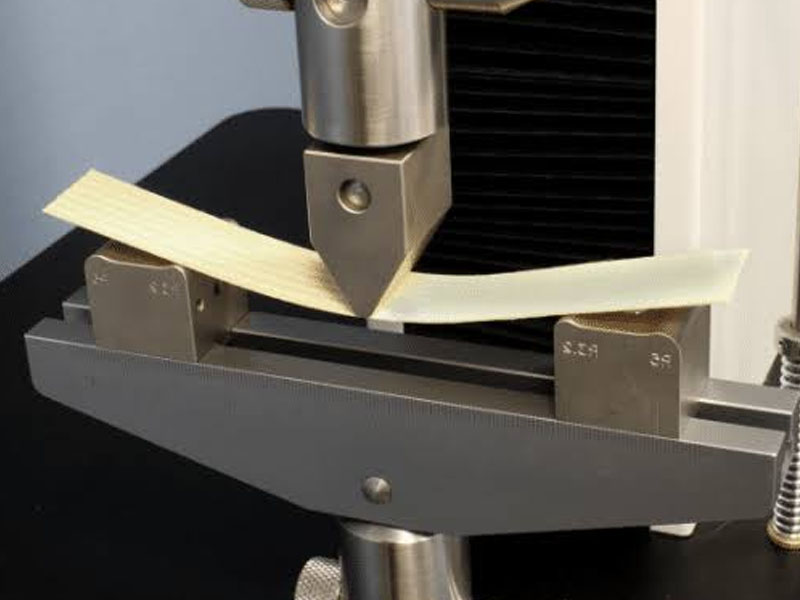
The three-point flexural test is the most widely adopted testing method for thermoplastics, modified polymers, and fiber-reinforced composites. The standard fixture consists of two bottom supporting spans and one central loading indenter. During operation, the universal testing machine applies concentrated load at the center of the specimen, generating maximum bending stress directly below the loading point.
Test parameters such as support span distance, constant loading rate, and maximum deflection displacement strictly follow ASTM and ISO standards. The obtained stress-strain curve accurately reflects material bending performance, making this method ideal for routine factory quality inspection, material batch testing, and basic mechanical property characterization.
Four-Point Flexural Test
The four-point flexural test is a high-precision testing solution designed to eliminate shear stress interference. Equipped with two lower supporting points and two upper symmetrical loading points, the fixture creates a pure bending section in the middle area of the specimen. Stress distribution is uniform across the pure bending zone without concentrated shear force.
This testing method effectively avoids premature specimen failure caused by shear stress, providing more accurate flexural strength and modulus data. It is widely applied in high-precision material research, aerospace material certification, and high-strength composite performance testing.
Core Testing Parameters for Flexural Performance
Professional flexural testing mainly measures three core mechanical indicators: flexural strength, flexural modulus, and bending deflection performance. These parameters quantitatively evaluate material stiffness, anti-deformation capability, and structural stability under bending load, which are the key basis for industrial material formulation and component design.
Specimen geometric dimensions directly affect test accuracy. For conventional thermoplastic materials, standard specimen size is 127 mm × 12.7 mm × 3.2 mm. Uniform specimen thickness, smooth surface, and standardized span setting are essential to eliminate test deviation and ensure data consistency. Standardized parameter control enables universal testing machines to deliver stable, repeatable, and highly credible flexural test data.