Flexural Strength vs Tensile Strength: Commonalities in Material Mechanical‑Property Evaluation
For most engineering materials, flexural strength is generally higher than tensile strength. If a material were perfectly homogeneous, its flexural strength would theoretically equal its tensile strength. In practical conditions, nearly all materials contain micro‑defects or macroscopic flaws that produce localized stress concentrations and create zones of material weakness.
During flexural loading, maximum stress occurs only at the outermost extreme fibres of the specimen. Provided these surface fibres remain defect‑free, flexural performance is governed by the integrity of these highly‑stressed outer layers. In a tensile test, by contrast, stress distributes uniformly across the entire cross‑section. Material failure initiates once the weakest internal fibre reaches its critical tensile stress. This mechanism explains why identical materials frequently exhibit higher flexural strength values compared to tensile strength.
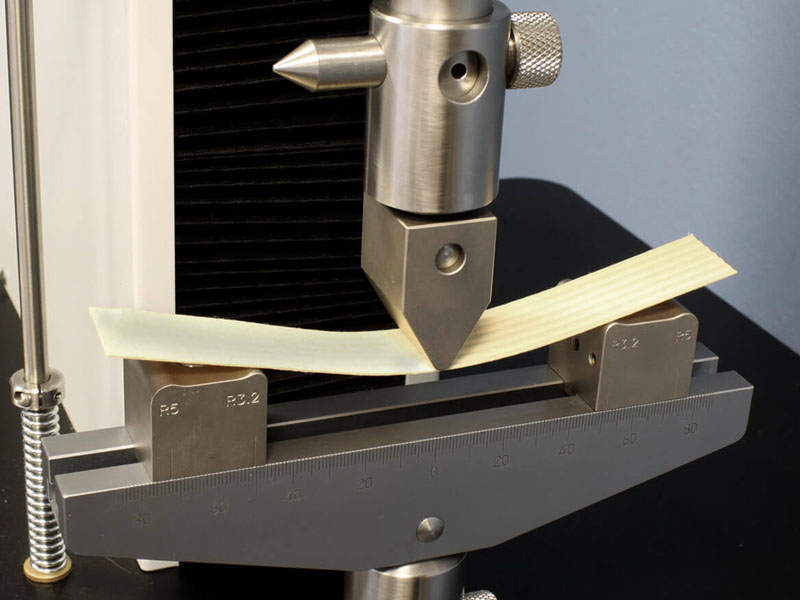
In special scenarios, tensile strength may exceed flexural strength. For instance, a homogeneous material with surface‑only defects such as machining scratches will fail under bending at lower stress, while its bulk tensile capacity remains less affected.
Excluding the influence of material defects, failure will occur under a bending load lower than the corresponding pure tensile load. Both loading modes trigger the same critical failure stress, which is an intrinsic material‑driven value.
Understanding Core Material Mechanical Properties
Mechanical material properties define how specimens respond under different applied loads and service environments. Mastering these metrics supports proper material selection for engineering components. Tensile strength and flexural strength represent two fundamental performance indicators.
Tensile strength refers to the maximum tensile stress a material can sustain before fracture. Flexural strength characterizes a material’s resistance against bending‑induced rupture. With clear knowledge of these parameters, engineers can make evidence‑based material decisions to guarantee structural safety and operational efficiency in component design.
Tensile Modulus versus Flexural Modulus of Elasticity
Modulus of elasticity, also referred to as Young’s modulus, quantifies material stiffness, defined as the stress‑to‑strain ratio within the proportional elastic limit. This parameter is critical for structural design, helping engineers avoid excessive elastic deformation under service loads.
When evaluating tensile and flexural behaviours, elastic modulus enables prediction of material performance and long‑term durability under tension and bending stress states.
Key Similarities and Differences Between Tensile and Flexural Strength
Tensile strength and flexural strength are frequently paired for material evaluation. Both properties measure a material’s capacity to resist mechanical stress, yet they correspond to distinct loading conditions.
Tensile strength assesses resistance to uniaxial tensile forces; flexural strength evaluates resistance to bending stress. Distinguishing their similarities and differences supports accurate material selection, ensuring components deliver stable performance under real‑world load scenarios.
Flexural Strength vs Flexural Modulus
Flexural strength and flexural modulus describe separate material responses under bending loads. Flexural strength reflects ultimate breaking resistance under bending stress, representing maximum load‑bearing capability for fracture prevention.
Flexural modulus measures stiffness, quantifying deformation resistance within the elastic range. Higher flexural modulus corresponds to superior rigidity and less bending deflection under applied load. Both indexes are vital for specifying structural beams, mechanical parts and sports‑grade components where bending resistance and anti‑fracture performance are required.
Tensile Strength vs Tensile Modulus
Tensile strength and tensile modulus are foundational mechanical indexes for tensile‑loaded applications. Tensile strength defines the maximum stress prior to tensile fracture, indicating ultimate tension‑direction load capacity.
Tensile modulus (Young’s modulus) characterizes elastic stiffness under tensile stress. A higher tensile modulus means smaller elastic deformation under given tensile loads. Engineers rely on both properties for structural members, cables and wire products requiring tensile resistance and dimensional stability.
Selecting Appropriate Mechanical Test Methods
Tensile testing and flexural testing are standard laboratory methods for characterizing mechanical performance. Tensile tests generate tensile‑strength data; three‑point or four‑point flexural tests determine flexural‑strength parameters. Test selection shall match real‑world service‑load conditions.
Where components mainly bear tensile forces, tensile testing is preferred. For parts dominated by bending stress, flexural testing delivers more representative data. Correct test‑method selection guarantees reliable measurement results and predictable in‑service performance.
Test Limitations & Practical Considerations
Although tensile and flexural tests are widely adopted for material qualification, each test method carries inherent assumptions and limitations.
Tensile testing presupposes specimen homogeneity and uniform cross‑section stress distribution; real‑world material defects can deviate actual performance from theoretical calculation. Flexural testing assumes pure‑bending stress distribution, which may not be fully achieved in every practical test setup. Recognising these constraints is essential for correct interpretation of test reports and rational material specification.
Conclusion
Accurate understanding of tensile strength, flexural strength and related elastic‑modulus properties forms the basis of engineering material selection. Elastic modulus guides anti‑deformation structural design. Proper test‑method selection together with full awareness of test‑method limitations ensures trustworthy mechanical‑property data. By integrating these factors, engineers can realise safe, efficient and functional component designs.